The Recovery Capacity Continuum
Recovery begins when we become aware that addiction has been creating problems and we begin to address those problems. For many of us, that begins with abstinence. For others, it begins with honesty, reduction, treatment, meetings, therapy, spiritual awakening, or the first clear admission that the way we have been living is costing us too much.
However it begins, recovery opens a door.
Sobriety -- abstinence from the addictive substance, process, or behavior -- gives us a chance to see what addiction had been managing. When the substance or behavior is removed, reduced, interrupted, or questioned, the system that depended on it is revealed. The anxiety is still there. The shame is still there. The fear is still there. The self-judgment is still there. The pressure to perform, manage, control, please, hide, escape, or prove ourselves is still there.
This is where deeper recovery begins.
Addiction often functions as a management strategy. It gives temporary relief from feelings, memories, beliefs, body sensations, and inner conflict that feel too difficult to face directly. The addiction may create enormous problems, but it also has a job. It helps us survive our inner experience.
When we begin to recover, we begin to discover what that job has been.
Sobriety Creates the Conditions for Recovery
I joined a 12-step group in 1982 and got sober. At the time, I did not understand that my alcohol use had been protecting me from the discomfort of unhealed emotional wounds. I got sober because my wife believed my drinking was a problem. I was afraid she would leave if I kept drinking.
That was enough to get me through the door.
I hated the idea of never drinking again. I hated the idea of calling myself an alcoholic. I resisted that label for about 30 days. I sat in meeting after meeting while others introduced themselves that way. I felt the pressure to comply. I also felt the internal resistance that rose up every time I imagined saying those words about myself.
Eventually, I did it.
I said, “I’m Bill, and I’m an alcoholic.”
The words barely came out. My throat tightened. My eyes filled with tears. My body reacted before my mind could explain what was happening. Something inside me felt exposed, ashamed, and cornered. Another part of me felt relieved to finally belong. Another part wanted the approval and acceptance of the people in the room. Another part craved the honesty, vulnerability, and raw human contact I found in those meetings. Another part began to feel proud each day I stayed sober.
At the time, I did not have language for any of this. I only knew that getting sober created a storm inside me.
Years later, through the Internal Family Systems model, I came to understand that these were parts of me -- not random reactions. They were not character defects or evidence that I was failing at recovery. They were parts of my inner system, each one trying to help me survive, belong, stay safe, avoid shame, and move forward.
That understanding changed everything.
Recovery Reveals the Parts That Have Been Managing Life
Many people in recovery assume the main problem was the addictive behavior. That makes sense in early recovery. The behavior is loud. The consequences are obvious. The wreckage is visible. The priority is often immediate: stop drinking, stop using, stop acting out, stop lying, stop hiding, stop destroying what matters.
That first layer of recovery serves an essential function. Sobriety can interrupt the damage. It can restore clarity. It can make repair possible. It can create enough space for honesty, connection, and healing to begin.
Then another layer appears.
Once the addictive behavior is no longer running the show in the same way, we begin to notice what the addiction had been helping us manage. We may discover anxiety that has been there for decades. We may discover shame that formed early in life. We may discover loneliness, grief, fear, rage, resentment, worthlessness, perfectionism, people-pleasing, or a constant sense that we are one mistake away from being exposed.
This can be discouraging for people in recovery. We may think, “I got sober. Why am I still so anxious?” Or, “I stopped using. Why am I still so hard on myself?” Or, “I’m doing the right things. Why do I still feel like I’m surviving my life instead of living it?”
Those questions point toward the next stage of recovery.
Recovery is more than the removal of the addictive behavior. Recovery is the restoration of capacity. It is the process of gaining access to the inner resources that addiction, shame, fear, and self-management have blocked.
Capacity Determines What Becomes Available
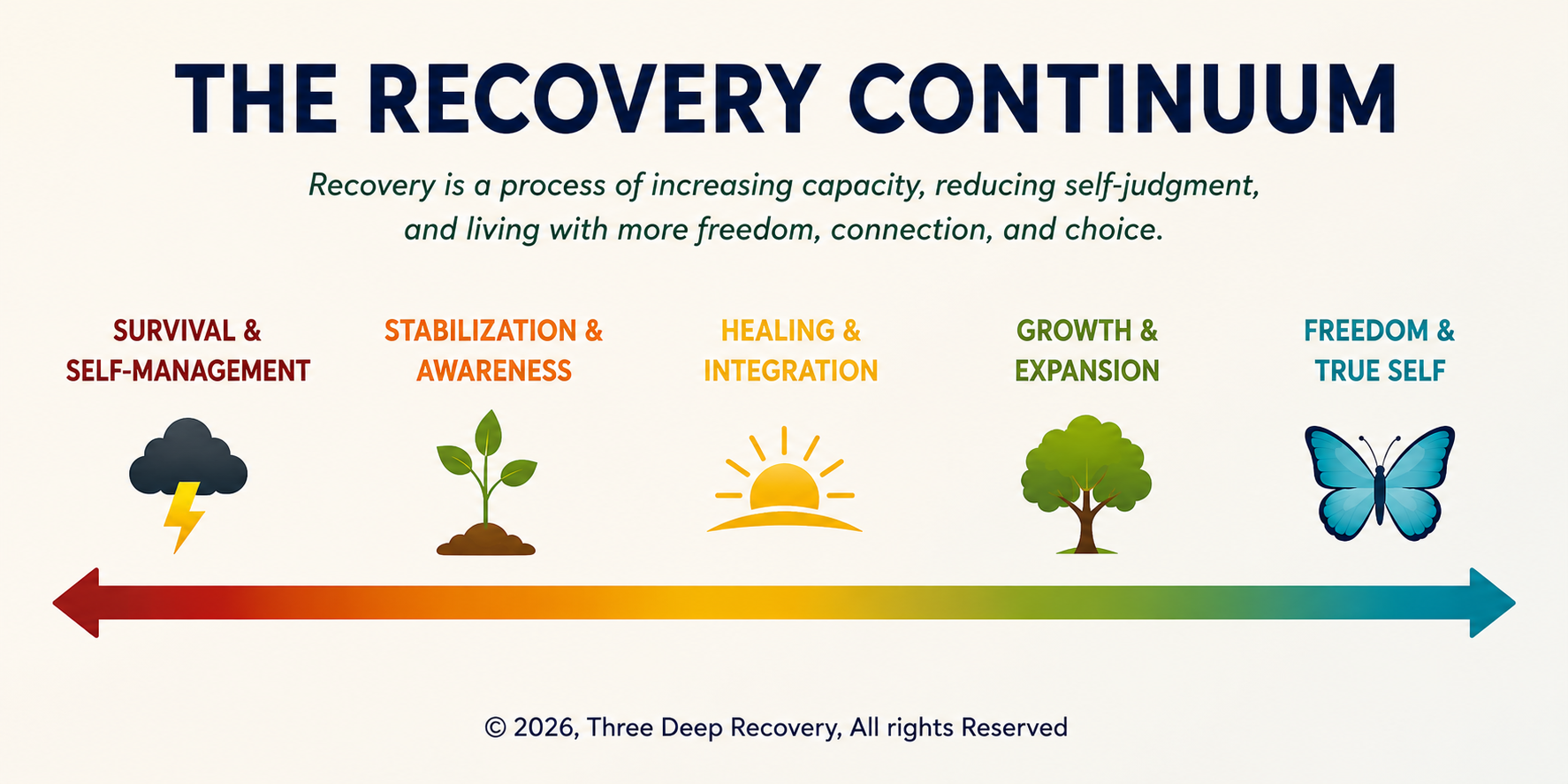
I think of this as the Recovery Capacity Continuum.
At one end of the continuum, life is organized around survival. The inner system is busy managing pain, fear, shame, threat, memory, and emotional activation. A person may appear functional on the outside while using enormous energy internally just to get through the day. They may work, lead, parent, attend meetings, help others, and keep commitments, while inside they are fighting a private war.
At this end of the continuum, growth is difficult because so much energy is being used for management. The person is managing feelings, managing reactions, managing urges, managing appearances, managing relationships, managing spiritual performance, managing recovery identity, and managing the fear of relapse or collapse.
When capacity is low, life becomes effortful. We rely on control, compliance, avoidance, pressure, urgency, and self-criticism. We may be sober and still feel trapped inside the same nervous system, the same shame, and the same internal conflict.
As capacity increases, more becomes possible.
We begin to pause before reacting. We notice activation without immediately becoming it. We recognize concerns as they arise. We become curious about our reactions instead of harsh. We begin to understand that the behaviors and reactions we have judged somehow made sense. We experience moments of space between impulse and action. We begin to feel choice.
At the other end of the continuum, life is no longer organized primarily around survival. There is more access to CORE Energy. There is more clarity, calm, courage, compassion, connection, creativity, confidence, and choice. We begin to live with more freedom because our energy is no longer consumed by managing ourselves.
This is deeper recovery.
My Own Recovery Moved Along This Continuum
For the first 20+ years of sobriety, I stayed involved in a 12-step program. I worked with others. I sponsored people. I went to meetings. I stayed sober. I embraced as much of what was suggested and inferred as I could.
And I felt skeptical, critical, and suspicious. I consistently questioned the culture of the program. I resented the efforts of long-time members who tried to bully me into their ideas of how I should work my program and live my life.
I wanted belonging, but I also wanted autonomy. I wanted approval, but I also wanted protection from humiliation. I wanted to make sure I would never again surrender my judgment to a group just to stay safe, but I also wanted me to keep recovering. I wanted to stop letting recovery become another experience of self-abandonment.
At the time, I experienced much of that as conflict. Later, I came to see it as valuable and important information about my internal world of perception and reactions.
My abstinence from alcohol has been essential to my life. Sobriety made it possible for me to find ways to heal and grow. Had I continued drinking, the patterns alcohol made tolerable would have continued. The progressive dysfunction of addiction would have consumed more and more of my life.
Sobriety gave me a foundation.
But sobriety did not instantly heal what alcohol had been helping me manage. That took time, self-inquiry, therapy, and the Internal Family Systems model. It took learning how to turn toward parts of me I had spent decades trying to control, silence, shame, or override.
When Growth Work Exposes Old Burdens
Almost 30 years after I got sober, I became a life coach. I began by using lessons I had learned in recovery to help my clients -- most of whom were not struggling with addiction -- reclaim power and choice in their lives.
I worked part-time as a coach for about five years and had strong results with clients. Eventually, I believed formal training could make me a better coach. Once I was earning enough money from coaching, I enrolled in a one-year coach training program that met one weekend a month in Seattle. Halfway through that training, I quit my full-time job as a mortgage loan officer and focused entirely on building my coaching practice.
I expected the training to make me more powerful and effective.
Instead, I lost my confidence.
As the year progressed, I became emotionally activated (triggered) most of the time. While other trainees seemed to be growing, learning, and integrating the material, I felt increasingly demoralized. An internal war raged. I hoped that if I could just hang in there for one more weekend, I would have a breakthrough and finally receive the value I had hoped for. At the same time, I wanted to quit and blamed the trainers and the program for what I was experiencing.
At the end of the training, I looked around the room. Twelve of us had completed the course. Most of the graduates seemed to have embraced the experience. I felt like I had survived it.
On the five-hour drive home from that final training weekend, I wondered what I would do with my life. I questioned whether I was capable of coaching others. I felt humiliated, hurt, angry, and afraid. I remembered one of the trainers saying that sometimes a season of therapy could make a difference for people who were otherwise too damaged for coaching to help. I was terrified to think that might be true about me. Was I too damaged to be a coach?
That was a painful moment. It was also an important one.
The training did not create the wounds it activated. It exposed burdens I was already carrying. It showed me where my capacity was limited. It revealed the parts of me that were still organized around shame, comparison, failure, approval, and fear.
I called a therapist and scheduled appointments. Fortunately, my new therapist used the Internal Family Systems model. After just four IFS sessions, I felt clear and confident again. I resumed my work as a life coach and went on to build a successful coaching practice.
Eventually, I completed two levels of IFS training, became a Certified IFS Practitioner, and began using IFS with most of my clients.
That experience helped me understand capacity in a new way. A person can be sober, functional, intelligent, committed, and sincere, while still carrying emotional burdens that reduce access to confidence, clarity, and choice. When those burdens are activated, the system shifts toward survival. When those burdens are met, understood, and healed, capacity increases.
Recovery Includes the Right Kind of Support
Different seasons of recovery call for different kinds of support.
Some seasons call for therapy. When emotional wounds, trauma, shame, fear, or instability require significant daily management, a skilled therapist can help provide the structure, safety, and clinical support needed for healing.
Some seasons call for coaching. When a person has enough capacity to engage growth work, coaching can help them access choice, take action, build trust with themselves, and create a life that reflects what matters to them.
Some seasons call for community. We need places where truth can be spoken, isolation can be interrupted, and human connection can become part of the healing process.
Some seasons call for education, spiritual practice, body-based work, medication, treatment, sponsorship, mentorship, or a combination of many supports.
The point is matching the support to the person’s capacity.
Capacity is a practical reality. When the system is using most of its energy to manage pain, threat, or shame, the next step is support that helps the system settle and heal. When the system has more access to steadiness, curiosity, and choice, the next step may be growth, creation, repair, leadership, or deeper alignment with True Self.
Recovery becomes more effective when we stop judging where we are on the continuum and begin telling the truth about what kind of support we need.
From Self-Management to Freedom
Many people in recovery live for years in self-management like I did.
They manage their thoughts. They manage their emotions. They manage their image. They manage their recovery. They manage their relationships. They manage what other people know. They manage how spiritual they appear. They manage their fear that they are one bad day away from losing everything.
This kind of management can look responsible from the outside. Inside, it is exhausting.
Self-management is often the work of concerned parts of us. These parts are trying to keep life from falling apart. They push, monitor, criticize, plan, prevent, perform, and protect. They may be harsh, but their intention is protective. They are trying to help us stay safe, sober, acceptable, connected, and in control.
As recovery deepens, our relationship with these parts changes.
We begin to acknowledge activation. We pause. We bring attention to what is happening inside. We get curious about the part that has become active. We listen for its concern. We begin to understand what it has been trying to prevent. We offer care, attention, and leadership from a steadier place within us.
As concerned parts begin to trust us, they soften. As they soften, more of our natural inner energy—the calm, clear, compassionate, and confident state that is available when we are not overwhelmed by parts—becomes available. As CORE Energy becomes available, personal power returns naturally. We no longer have to force ourselves into change. We begin to move from clarity, choice, and alignment.
This is the movement from survival to freedom.
Recovery Restores Access to True Self
The deeper promise of recovery is the recovery of True Self.
True Self is the person beneath the shame identity, the false identity, the survival strategies, the addictive patterns, and the protective roles we learned to play. True Self is not manufactured through self-improvement. True Self is uncovered as the system becomes safer, less burdened, and more open to CORE Energy.
This is why recovery is a capacity-building process.
As capacity increases, we become more able to tell the truth. We become more able to feel without being flooded. We become more able to listen to parts without being taken over by them. We become more able to repair relationships, set boundaries, make choices, and live according to what matters.
We begin to trust ourselves.
That trust grows as we discover that our inner experience is workable. Our thoughts, feelings, urges, and reactions become information. Instead of using shame to control ourselves, we use awareness to understand ourselves.
Awareness creates space.
Space makes choice possible.
Choice increases freedom.
Where Are You on the Continuum?
Each of us in recovery can locate ourselves somewhere on the Recovery Capacity Continuum.
At times, we are closer to survival. We feel reactive, ashamed, afraid, overwhelmed, resentful, urgent, or controlled by old patterns. We may be sober and still feel like life requires constant effort.
At other times, we are closer to freedom. We feel clearer, steadier, more connected, and more able to respond rather than react. We feel access to inner resources. We sense personal power without force. We recognize that we have choices.
Most of us move back and forth along the continuum. That movement is part of recovery. Capacity changes. Parts become activated. Life brings pressure. Old wounds surface. New support becomes available. Healing happens. Freedom increases.
The work is to notice where we are with honesty and compassion.
Recovery is a process of becoming more available to life. It is the movement from managing ourselves to understanding ourselves. It is the movement from shame to curiosity, from survival to capacity, from control to trust, from addiction as a management strategy to CORE Energy as a source of personal power.
Sobriety opens the door.
Deeper recovery teaches us how to walk through it.