Geoff: love isn't enough to make a marriage work or a committed romantic relationship work. It is not enough. It's the bare minimum. It's the ante to be in the game.
Geoff: made a commitment, and if I'm ever gonna give up on this thing, it ain't happening until we have done everything, and I mean fucking everything, to work through the issues and the challenges and find our way back to each other."
Geoff: I'm the one that has to deal with my shit.
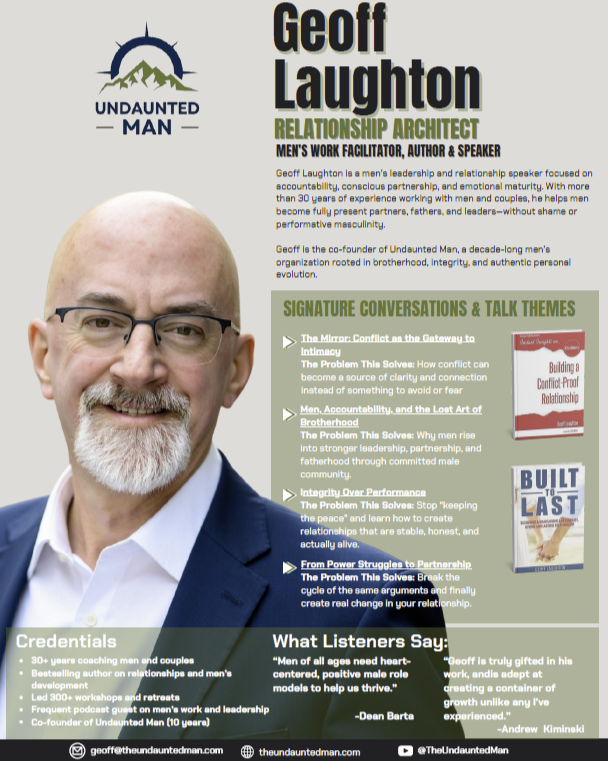
Bill: Welcome to another episode of the True You podcast. My name is Bill Tierney. I'm a compassionate results coach. This is my co-host, Dr. Martin Kettelhut, Marty. He's an author and a coach as well, a leadership coach. joined today again by Lofton, a relationship architect coach. He's a men's work facilitator and author and a speaker.
You wanna say hello, Geoff?
Geoff: Hello. Thank you for having me. Great to be here again.
Bill: Yeah, absolutely. And I say again, and you say again because you were on our leadership, Coaching podcast. I don't think you've yet been on the
Marty: That's true. We've changed the theme since then.
Bill: Yeah. Yep. And you were here...
Geoff: got rid of our hair in the interim.
Bill: I don't know that we had any then either. think you previously were here with your, uh, business partner Mark,
Geoff: Yeah.
Bill: the...
Marty: that's right. Mm-hmm.
Bill: Yeah, in,
Geoff: man. Yeah.
Bill: in The Undaunted Man. That's right. Okay, so well, let me just read a little bit to, for those that haven't met you yet, Geoff, to, or for those that have and remind, remind them of, of a few things about you. me, A men's leadership and relationship speaker on accountability, conscious partnership, and emotional maturity. With more than 30 years of experience working with men and couples, you help men become fully present partners, fathers, and leaders without shame performative masculinity. You're the co-founder of The Undaunted Man, a decade long men's organization rooted in brotherhood, integrity, and authentic personal evolution. You are the author of "Building a Conflict-Proof Relationship"
Marty: We
Bill: And we, uh, we spent a few minutes before we hit record today because Geoff, you just came out of a pretty profound experience.
You feel, feel like sharing anything about that?
Geoff: Sure. I was-- I just, Mark, my business partner, was having a conversation with my spiritual teachers, and I use the word in the plural because my-- I have a human teacher, and I have, uh, literally a spiritual teacher that?
has been out of his body for a good 130 years. And, um, we were talking
Marty: might need to say a word about how it is that you could be talking to somebody who's been out of their body
Geoff: Uh, yeah. My human teacher is a trance channel
Marty: I see.
Geoff: has been channeling different spiritual energies now for about 35 years.
Marty: Mm-hmm. No
Geoff: been one of her students for 30 now. And the energy that came through for Mark and I today, um, it's really been a spiritual source for the Undaunted Man, is, um, the spirit of Chief Joseph, who was, um, in his last embodiment, the chief of the Nez Perce tribe in the late 19th century. Uh, well, really, he died in 1901 or 1902. But, uh, his tribe was in Washington State, uh, and Oregon, and he is one of a few Native American chiefs of that time that addressed both houses of Congress. After the military, he-- At great risk of life and loss of life for his tribe, when the, uh, US Army was coming to try to run them off their reservation, they ran to, towards the Canadian border, and it was in the wintertime. And he lost nearly half the tribe, and the army captured them literally hours away from the border. And so I have a huge, you know, here's a man really known in history and on the record for giving one of the most inspiring speeches to Congress in that day. And we were talking today about division and war. And over all the years that I've been studying with him and other, other spiritual beings and human teachers, the-- there's a recurring message and theme that I keep getting about the fact that There's a universal law that says, "As within, so without." And there's another law, universal law of correspondence is what it's called, which is, "As above, so below."
Marty: Mm-hmm.
Geoff: And I'm still-- I was sharing with Bill and Marnie before we hit the record button, I'm still... I mean, I have a lot to process from it, but it, it brings up that the wars that we've gone through for most of human history, just a perspective, um, and as a relationship coach, I'm always working with couples at war with each other. And that the war that goes out here is to varying degrees about the war that we have in here, whether that's the war between our higher self and our ego, if that's the war between, uh, our parts that Bill talks and writes about all the time, our young childhood adolescent parts. And so it really... What made me excited to come back and talk with you guys with this new, new podcast theme, The True You, um, in this reading, one of the practices that we were given to be able to have a bigger impact on the men that Mark and I serve, the couples that I serve, the women that I serve, is really about how we find peace. And then how can we bring peace to those around us? How do we bring peace to our family, our children, our grandchildren? It touches into a lot of worry I have for what my son and my grandson are facing when I'm long gone. Um, so I don't think there's a more important thing to be thinking about or working with and Because the invitation to be with you guys today was around relationship, that has to include relationship with self, which drives a lot of how our romantic relationships go, our friendships, professional relationship. And, um, part of the practice we were given was to grieve, grieve the arrogance, grieve the loss of humanity. I mean, what's happening in all the relationships I work with and everything that we're witnessing around the world, it's not just in the US, but globally, it's all this, it all centers around forgetting that we are all connected. We are all one. And yet for all of history, somehow that all went away. And we don't think twice about treating our partner that we keep saying, "I love you." And then we can treat them like they're our enemy. We can bomb school children and not bat an eye because of whatever reason. So this is really, you know, I'm stirred up and I'm grateful for the message. And I'm reminded, we're talking about, you know, romantic relationships here, that there's a fascinating paradox between the fact that love, the way I look at it and feel it, love is the only way out of this. And in romantic relationships, something I tell every couple I work with, and it's the first chapter of my first book, love isn't enough to make a marriage work or a committed romantic relationship work. It is not enough. It's the bare minimum. It's the ante to be in the game.
Marty: Mm-hmm.
Geoff: You know, that's the metaphor that resonates a lot with me.
Marty: Mm-hmm. Mm-hmm.
Geoff: All right. If we're gonna do this thing, if we're gonna, if we're gonna enter into this, you know, purported lifetime contract with each other because we love each other, then it's gonna be a rocky road. In the best of marriages, it's a rocky road, rollercoaster, and the love can be the glue that helps you get through more, you know, ego-oriented, psychological, mental stuff that we all grapple with. Um, so I just find that paradox perplexing, fascinating, and probably a huge part of my life purpose is to help bring clarity to that for myself, for couples, my clients, my friends. How do we navigate that paradox? So thank you for letting me have a little TEDx talk right in the first 10 minutes of
your That was wonderful
Marty: much in what you said, um, to talk about. Um, I hear, on the one hand, that,
love is just the ante to be in the game. And, and so there are a lot of games that we're in that you mentioned outside of our already existing love relationships or relationships with people that we love, um, that we, we- where that's...
We don't, we haven't even paid the ante to get into the game yet. So that's one thing to talk about. How would it-- what does it look like to bring love to, you know, the larger world outside of those relationships we've already declared have to do with love? Um, and then, uh, the other thing that is then, okay, now we're in the game, let's say with our spouse, um, what,
Geoff: Well,
Marty: what more does it, what more do we need to bring to the game besides just the ante?
Geoff: to start with?
Marty: start with the, the internal one.
Geoff: so I think it might be, it might be helpful for the audience To have a little bit of context about why I even do relationship coaching for a living,
Marty: Mm-hmm. Hmm.
Geoff: having been fortunate to be in my relationship with my wife for, um, 44 years. And I often say we have the most perfectly imperfect relationship you could ever want. Um,
Marty: Well, that says quite a bit right away, you know. Um, y-you know, just the acknowledgement that it's not about being perfect. Uh, the, the... And you mentioned this in another way earlier, the, you know, that relationships do have their ups and downs. They're not... If it, if it's not going perfectly, welcome to the game.
Geoff: Right. Well, yeah, exactly. It-- And why that inspires me to do what I do is because, you know, plenty of people can be together 45, 50, 60, 70 years.
Marty: Mm-hmm.
Geoff: another thing that I haven't been shy about telling people, you know, my parents were together for 50 years, and they hated each other for 49 of them. So it doesn't mean a fucking thing to me, the longevity, without there being the quality. And Sarah and I have been, you know, I think we're, we're probably on our fifth marriage right now
Marty: Interesting.
Geoff: with each other.
Marty: Uh-huh.
Geoff: You know, if I look back over the four and a half decades, there's four distinct periods that we've gone through, and the transitions between each one, um, to say they were rocky would be an understatement.
Marty: Hmm.
Geoff: And yet we have kept persevering, and we've moved through things that just from my practice, you know, my professional practice, would and has killed many a marriage.
Marty: Wow.
Geoff: And yet we're still here. We still love each other. We still like each other. We still sometimes get challenged to look each other in the eye for more than about 20 seconds because we both just start bawling.
Marty: Hmm.
Geoff: Because the love is so deep. So I'd love for more people to have that. So people ask me, to your question, "Okay, now you've antied up. Now how do you play the game?"
Marty: Yeah.
Geoff: When I try and reconstruct, like how have we pulled this off? Well, there's no question that, that ante has held solid this whole time. Another element of it, and maybe, you know, it-- another thing about us that's unusual is she's 11 years older than I am, and she was married and had a kid before we met. And so she grew up in the '50s and the '60s with parents who taught kind of the values of, like Christian values, and kindness meant something, and commitment was not to be taken lightly. And so I can't overstate the value of commitment. Now, I don't believe, by the way, that every marriage is meant to last a lifetime. I've been doing this too long to believe that. There are just some that are meant to last a certain amount of time, and both people get everything their souls and their minds needed, and then it's time to move on to the next best fit for wherever their spiritual and human evolvement is going. But for those who are lucky enough, at the risk of being contradictory, to make it this long the way we have, the commitment to not giving up it gets hard.
Marty: Mm-hmm. Mm-hmm.
Geoff: You know, and for you out there, Marty and I have been friends for 20 years He's seen some of these transitions we've gone through.
Marty: Mm-hmm.
Geoff: And man, there were times, I can't speak for Sarah, but there were times where my mind and my parts were going, "Oh, this would be so much easier to get out of this. Let, let's just give up." And something in me just, "No, I'm not gonna give up.
Marty: Mm-hmm.
Geoff: made a commitment, and if I'm ever gonna give up on this thing, it ain't happening until we have done everything, and I mean fucking everything, to work through the issues and the challenges and find our way back to each other."
Marty: So just to, uh, just wanna s- pull a thread here,
Geoff: Yeah.
Marty: don't mind my jumping in. So besides the ante of, of we love each other, and n- now I'm speaking to the what's going on inside is what's going on outside part of what you said.
Geoff: Exactly. Yeah. Um,
Marty: to, to working through whatever it takes to maintain and grow that love, then I'm not r- I've just paid the ante, I'm not even playing the game.
Mm-hmm.
Bill: I've got-- Do you mind if I jump in a little bit and, and share a couple of things that, that are going on in my mind as I listen, Geoff?
Geoff: Please, it's your show, bro.
Bill: Well it was your show, I'd still be asking permission. It doesn't matter that it...
Geoff: know. I know. And Bill and I are old friends too, so
Bill: yeah, 10, 10, 11 years, I think. Yeah.
Uh, so first of all, I'm thinking about my first marriage as you're talking about love as the ante, now that Marty's brought up commitment.
And so I'd like to just share a little bit on a personal note about what happened in that marriage
Geoff: Yeah.
Bill: um, and maybe it'll give a little bit even more context to what can happen. Um, so was 19. was 15 when we met. On our first date, by the end of that first date, I felt as much love for her as I ever did, that love for her continued for probably the first, I would say, 13 years of our
Geoff: Mm-hmm. Mm-hmm.
Bill: When we'd been together 15 years, she died of a brain tumor. But a couple years before she died of that brain tumor, out of love with her, and I lost my commitment. And so what it makes me wonder, and I've almost gotten all the way to the end of this road and, and drawn the con- conclusion that what I thought was love was not, in fact, love at all. That it was a need that I wanted her to meet in me, and I really believed that she could. And as, as long as I believed that and felt that, I was committed. But, but when the course of our ongoing negotiation of the relationship, it became clear that she not only was not capable but not willing to try to meet that need, I lost love for her, I lost the, the commitment to staying in the marriage. We did stay in the marriage e- e- eventually after some very rough and rocky roads, but my commitment was more for the desire not to hurt her as well as the desire to not hurt my kids.
Geoff: Mm-hmm. Mm-hmm.
Bill: So I think, I think maybe theoretically I'll throw... I'll just toss out here that what you're talking about as far as love maybe is confused a- as it w- was for me. Um, let me just fast-forward. After my first wife died, rather than grieving that, 'cause I didn't know how, I d- I just moved my attention to something that I could hang that n- unmet need on, which was more relationships
Geoff: Yeah.
Bill: I got involved with after two...
at, at about the two-year mark. And I never did actually feel anything like that love for her. Um, and because of the absence of that, as well as the commitment to treating each other with love and respect, we were committed to staying together and, and managed to just let that commitment keep us together for eight and a half years before just couldn't, couldn't continue. I, I became desperately afraid that I was gonna repeat more of just w- finding myself almost, uh, unconsciously and involuntarily falling into more relationships like that.
Geoff: Mm-hmm.
Bill: So I, I became convinced that I needed to do my work so that that wouldn't happen, and I did. And when I met my current wife, I didn't feel for her what I felt for my first wife.
Geoff: Mm-hmm.
Bill: felt love for her, but it was much, much different than what I felt for my first wife.
Marty: Hmm.
Bill: It was, it was a l- a needless love that has only grown over the 13 years that we-- we'll be 13 years married this, this summer. And, um, and I'm absolutely committed. is too. We've had some rough times, but, um, I, I, I just wanna reinforce maybe what you're saying about love being the ante. But the question is, what is that? What d- what does that even mean to love someone? need someone? If we listen, li- listen to the love songs, that's, that's what we hear, is to love someone is to need someone
from much of them, and that's not the case. Need is not love.
Geoff: No.
Bill: Yeah.
Geoff: No,
Bill: So that's kind of what's on my mind.
Let me just be quiet and hear, hear some responses from you and Marty.
Geoff: Well, I love that you bring that up because I think, you know, I've also really grown over time to see, you know, a biological fact is for most, if not all of us, when we, quote-unquote, "fall in love," um, is exactly how you just described what you had with your first wife. It-- we fall in love, and most people get into a relationship in a state of chemical intoxication,
Bill: Absolutely.
Marty: Mm-hmm.
Geoff: the...
Bill: in fact, that, that's what people-- we all say we want. We want that chemistry.
Marty: Mm-hmm. Okay.
Geoff: is just biochemistry on one
Bill: Yeah.
Geoff: and then that always wears off. You know, the last thing I read about that general time period is within one to three years.
Bill: Yeah.
Geoff: And so I think this also ties in nicely with commitment, and Marni used the word respect, and you used the word respect, that when that limerence, that's the name for that biochemical phenomenon, when that wears off, then you have to look-- you know, you suddenly realize who you're with.
Marty: Hmm. Mm-hmm.
Geoff: And I, I read this great article last-- a week or two ago by a therapist named Constantin Petrascu, and the headline of the was, "Most Marriages Are Dead Before They Even Start." Because, he writes, we tend to marry, marry literally or figuratively, the fantasy, which is what you were-- you know, your first wife, she The-- needs that you hadn't had met growing up, you know, in your family, um, and what I hadn't had, you know-- Now Sarah was my third relationship, so there was still an element of, "Oh, this is the person that's gonna meet these needs that I had yet to have had met." So think another thing that can really determine if there's life beyond limerence does require some struggle. Like, you have to get to know who you've actually married, and you have to get to know you in a more sober way,
Marty: The-- yeah, exactly. Um, can I jump in? I don't wanna...
Geoff: No, no.
Marty: And the-- and I think this goes back to the bigger theme too, um. I take it that
God's creation is perfect, so to speak. That it, it all works. There's enough resources for everybody that, you know, it's-- there's a s- there's a state of grace And then we develop these internal, um, ways of handling ourselves that aren't-- that get in the way on, uh, uh, eventually to, uh, to, to being in this Garden of Eden kind of situation, right?
I think that's the whole, the whole Garden of Eden is a metaphor for what I'm talking about. Um, I don't read the Bible literally. I read it as parables and stories that are meant to teach us something. And so the love is just that recognition that this, you know, the, the-- this is good, you know, if one-on-one politically, you know, and that we've got what we need to make this work.
That's what I take the love to be. And the commitment is the part that says, "When my shit comes up, I'm gonna h- I'm gonna work on me so that we can get back to the Garden of Eden."
Bill: It doesn't mean I'm gonna tolerate your shit no matter what?
Marty: No. No.
Bill: Well, I think that that's what I used to think.
Marty: Mm-hmm. Mm-hmm. Mm-hmm. Hmm.
Bill: I'm gonna put up with you this crap
Marty: Instrument. We use people
Geoff: Well, and there, there's a-
Marty: as instruments of our
Geoff: or maybe that's not the right language. There's another piece of this that you're saying, Marty, that when thing-- you know, when the fantasy begins to drift away and you are having to deal with conflict and disagreement and different beliefs, et cetera, I think a lot, at least a lot of the people I've worked with over the years, whether they're consciously aware of it initially or not, a lot of people have the belief that your job as my partner is either to make my life work for me
Marty: happiness. Like, "I'm gonna
Geoff: shit and I don't wanna deal with it, well then you also get to be my punching bag, my therapist, my security blanket, my mommy or my daddy.
Marty: use you to do this. I'm gonna use you to make this happen. I'm gonna use you in this way for me."
Bill: because you are my everything.
Geoff: Ugh.
Bill: sounds lovely in a song, but, but it's scary as hell when you really think about what, what the, what that means. what you're saying you're-
Marty: Mm-hmm.
Geoff: I mean, in a way, in retrospect, I loved it at the time, but in the ensuing 20 or 25 years since "Jerry Maguire" came out, you know, "You had me at hello," and, "You complete me," I wanna fucking vomit. That movie has done more disservice, you know, between that and Hallmark,
Marty: Yeah.
Geoff: whole idea that you're my everything.
Bill: Mm-hmm.
Geoff: And when I run into couples who believe that or think that ought to be the way it is, what I say to them is, "No one, love partner, your best friend, no one can be your own personal Walmart."
Marty: Mm-hmm. I just find that funny because I was just talking to a friend today about how there are certain things that Walmart's really good for, but not everything. And,
Geoff: Right.
Marty: now you're-- it's as if Walmart had everything, uh,
Geoff: Yeah.
Marty: that...
Geoff: Yeah. And, and I think this also opens up the role that maturity-
Marty: Mm-hmm.
Geoff: Ultimately, ideally plays
Marty: Mm-hmm.
Geoff: because when Sarah and I got together, I was 24. And another thing that I see has helped us make it through some very difficult times was ultimately, and maybe her to a degree, but I think when you've already been married, divorced, and been a single parent, um, you grow up pretty fast when you're in that kind of a situation.
Marty: Mm-hmm.
Geoff: Um, I hadn't had a kid before she and I had our son together, which was not planned. Um, so I had to really-- and I don't think I really started getting it until I was in my late 30s or early 40s. I'm the one that has to deal with my shit.
Marty: Mm-hmm.
Geoff: I've gotta do my healing. I've gotta own... And that's another huge reason why a lot of marriages are so divisive if you think your partner is going to be able to or even should your emotional dysregulation or handle your inner tug-of-war between, "I really wanna be a hippie, but I really like my seven-figure income." And, you know, any of those internal cognitive dissonances that we all deal with at one point or another, well, you're, you're pointing in the wrong direction. And, you know, when somebody taught me the thing around when you point your finger at someone, there are three of them pointing back at you.
Marty: Mm-hmm.
Geoff: first time I heard that, my first thought was, "Well, fuck you." No, it goes right over there.
Marty: Mm-hmm.
Geoff: So I, I think that is a huge... Every couple I work with, relatively soon into the work, that's one of the first things I have to either teach them that they've never known or I have to remind them.
Marty: Mm-hmm.
Geoff: No matter how poorly behaved your spouse might be, you still are fully at choice around whether you're gonna react to that or respond. And while you're not responsible for your partner's behavior, you are responsible for your impact and your dynamics that inadvertently or advertently create that impact. So... you really have to look here first always
Marty: Right. Right. Um, I wanna go back to my thread, if you don't mind. No,
Geoff: I'm s-- yeah, sorry, I went a
Marty: no, not at all. No, all of this is relevant. I'm j- I'm just-- This is sort of like the teacher in me, like, "Okay, so what we've been learning, boys and girls, is..."
Um.
Bill: Thank you, Mr. Kettelhut.
Geoff: doctor in you,
Bill: you, Dr. Kettelhut.
Marty: Well, 'cause I'm learning, I'm learning this, and so it helps me to repeat it what I'm hear- what I'm learning. I don't mean to be pedantic, no, it.
Geoff: not.
Marty: so w- the love is there, the chemicals are flowing, then things start to get rocky. I got, I've gotta recognize I'm committed to this, and I gotta deal with myself in order, um, to make the right choices. This is the next piece of the thread I hear, is we have, we have to recognize we're at choice. We could choose, like, this isn't gonna work out We're not meant to be together forever is one of the options.
You know, I love you and I'm moving on, and I think you should too.
Geoff: Yep.
Marty: or okay, I gotta choose how I'm gonna get this because, like, I'm dealing with cognitive dissonance and my wife isn't a therapist. So choose to, to get help or choose what-- choose be a choice at, at every moment. And, and I'm just gonna s- like anticipate that the next piece of the thread or maybe where it all wraps around is, um, to the peace that, uh, Chief Joseph, Joseph brought out.
Like if we have to be at peace within to deal with our own cognitive dissonance, let alone sustain it, you know, sustain the commitment that goes back to the love. And so I, you know, I think what I'm-- I'm, I'm really impressed with the, the way you o- your TED Talk at the beginning, and I'm trying to keep the thread tied to that is what I'm trying to do here.
And I'm, and I'm thinking that we have to have connection to inner peace if we're gonna deal with our own cognitive dissonance, to make the right choices, to stay in the commitment to love.
Bill: I'm gonna ask, I'm ask Geoff for you to respond to that, and then we need to wrap up for today. And I'm wondering also if after we stop the recording, we can look at our calendars, 'cause Geoff, I'd love to keep this conversation going if you're available for that.
Geoff: Absolutely. Yeah. Um, so Yes, that was a great recap, Marty. And track around what comes next and how do we get peace within ourselves.
Marty: Mm-hmm.
Geoff: you know, I remember one of my early mentors 35 years ago now gave me the perspective, you know, both on a spiritual and a, you know, human level, we tend to attract partners that are going to help us heal, whether that's by illuminating the dark shadow wounds that we haven't recognized or seen or owned or all of the above yet.
Marty: Mm-hmm. Mm-hmm.
Geoff: And, you know, when I look back on Sarah and I, um, thank God she was more mature than me for a long time because I was so blind to where I felt broken inside. I was blind to the impact of the considerable traumas I went through growing up. And so to find inner peace, there, there is a blend of the essential need to take 100% responsibility for your experience of your life, good, bad, and ugly.
Marty: Mm-hmm.
Geoff: There's no negotiation in that formula. I'm 100% responsible for how I experience myself my life. And when I started to get that, and just to be transparent, that's still a work in progress.
Marty: Yeah.
Geoff: I have to remind myself of that, you know, at least a few times a day, um, that I have to also be able to know and own my shadow, face it, learn to appreciate it for the gifts that it has, and to not let it shit the bed in my life as much as possible.
Marty: Mm-hmm. Mm-hmm.
Geoff: So I think that- Again, as I look at the arc of Sarah's and my relationship and the relationships I personally know of that, you know, are comparable to ours, that's been a key thing. you hit the wall and the conflict starts escalating and you're triggering each other right and left,
Marty: Mm-hmm.
Geoff: if nothing else, that's, in my way of thinking, that's m- your spirit letting you know the next piece of wholeness for you is to go into these wounded, broken parts of ourselves. And that takes courage and patience, resilience, and about five gallons of tenacity a day.
Bill: Listeners, he is Geoff Lofton, and he can be reached at Geoff@theundauntedman.org. And his, uh, website is... Help us out, Geoff. theundauntedman.com.
Geoff: theunknottedman.com and for the relationship work I do,
Bill: Thank you for joining us, and let's get you on the calendar again very soon. Great. Thanks,
Thanks, Geoff. Thanks, Marty. Till next time.
Speaker: We appreciate who you are, that you would be listening to this podcast, and want to acknowledge all those parts of you that yearn for the experience of the true you.
Speaker 2: If you liked this episode, click like, share it with others, and be sure to subscribe. Listen again next week for the newest episode.
Speaker: Check show notes for a transcript and a link to resources, including a link to let us know if you'd like to be a guest on our podcast.
Speaker 2: Thank you for listening and going on this journey with us back to the true you.