Feeling Overwhelmed? You’re Running Out of Capacity—and Here’s Why

Understanding what’s draining you, what restores you, and how to create more capacity for your life
You wake up already a little tired.
Not exhausted, but not fully there either. You move into your day, and it doesn’t take much before things start to feel like too much. A conversation feels heavier than it should. A small problem feels bigger than it is. Your patience shortens. Your mind speeds up or shuts down.
It’s easy to assume something is wrong with you. That you’re not handling life as well as you should.
But what if that’s not what’s happening?
What if you’re not overwhelmed…
What if you’re running out of capacity?
The Energy Behind How We Live
Throughout the day, we are constantly responding to what comes our way. Conversations, decisions, challenges, responsibilities, interruptions. Each of these requires something from us.
That “something” is capacity.
Personal capacity is the mental, emotional, and physical energy we have available to meet life as it happens. It determines how we think, how we feel, how we respond, and what we are able to access within ourselves.
Some days feel easier than others. Some moments feel manageable, while others feel overwhelming. The difference is often not what is happening, but how much capacity we have available when it happens.
What Builds Capacity and What Drains It
Not everything we do affects us the same way.
Some activities, habits, and practices restore capacity. Others deplete it.
It is useful to begin noticing the difference.
Rest, meaningful connection, movement, nourishment, and moments of presence tend to restore capacity. Overextension, unresolved conflict, avoidance, poor sleep, and constant stimulation tend to drain it.
Without awareness, we move through life unintentionally spending capacity faster than we restore it.
With awareness, we begin to see patterns. We can identify what helps and what hurts.
Capacity Affects Everything
Our available capacity impacts us mentally, physically, and emotionally.
It affects:
Our ability to think clearly
Our ability to regulate emotions
Our patience and tolerance
Our access to creativity, compassion, and curiosity
Our ability to respond instead of react
When capacity is high, we tend to feel more grounded, flexible, and capable.
When capacity is low, we become more reactive, more rigid, and more easily overwhelmed. We may shut down, avoid, or push ourselves in ways that aren’t sustainable.
Why We Don’t All Start the Same
Not everyone begins the day with the same level of capacity.
Some people wake up feeling resourced and ready. Others wake up already depleted.
There are many reasons for this:
Mental health
Physical health
Emotional health
Quality of sleep
Stress levels
Life circumstances
And one of the most significant factors is the unresolved past.
The Hidden Cost of What Goes Unresolved
Every experience we have requires energy to process.
When something happens that we cannot fully resolve, it does not simply disappear. It stays with us in some form, and our system continues to manage it.
This management requires capacity.
Think of it like leaving your car lights on overnight. You don’t notice it while it’s happening, but in the morning, the battery is drained.
Our internal world works the same way.
Every unresolved problem, rupture, threat, or challenge draws on our energy. Over time, this creates a constant, unconscious drain on capacity.
We are, in a sense, walking around with the lights always on.
Living with Reduced Capacity
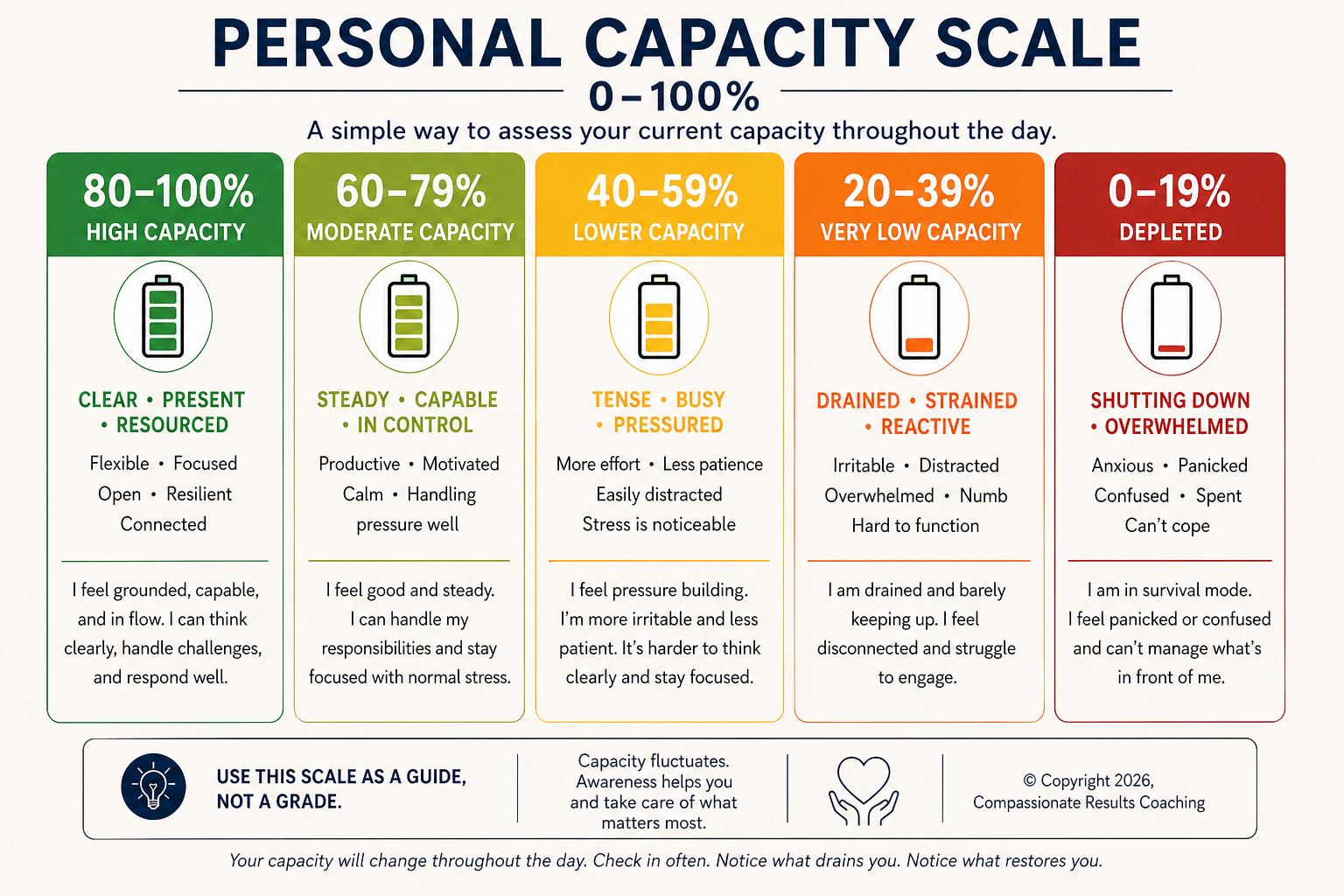
Imagine that optimal human capacity is 100 percent.
Even under normal circumstances, most people do not start their day at 100 percent. Maybe it is closer to 80 percent. As the day progresses, that capacity gradually declines.
Now imagine someone whose internal world is using significant energy to manage unresolved trauma, neglect, or chronic stress.
They might start the day at 50 percent.
Within a few hours, they may be operating at 30 percent, then 10 percent.
This means they are navigating much of their day with very little capacity available.
From the outside, this might look like irritability, withdrawal, low tolerance, or inconsistency.
From the inside, it is simply the reality of trying to function with limited resources.
Managing Capacity Versus Increasing It
When capacity is low, we instinctively try to manage our environment.
We avoid conflict. We reduce demands. We withdraw. We conserve energy.
This is similar to how a phone enters low power mode. We turn off features, close apps, and limit activity to extend what little energy remains.
There is nothing wrong with this. It is adaptive.
But it is also limited.
If we only focus on managing life around low capacity, we remain constrained by it.
A more effective approach is to increase capacity itself.
What Increases Capacity
Increasing capacity involves improving both how we live and how we relate to what is unresolved within us.
Mental and emotional health includes self-awareness, presence, emotional regulation, resolving internal conflicts, and addressing the impact of the past.
Connection includes meaningful relationships, support, and co-regulation with others.
Inner work includes understanding what remains unresolved and reducing the internal effort required to manage it.
Physical health includes sleep, nutrition, and exercise.
Direction includes a sense of purpose and an intention to take responsibility for your capacity.
The Role of Presence
There is a paradox in all of this.
The qualities that increase capacity, such as clarity, compassion, and groundedness, are already available within us.
But accessing them requires capacity.
And the doorway to accessing them is presence.
Presence means being aware of what is happening right now, without immediately reacting, avoiding, or getting lost in it.
A simple story illustrates this.
A woman tells her friend, “I don’t know how to be present.”
The woman lightly punches her friend in the arm.
“Ouch,” the friend says.
“That is one way to be present,” the woman replies.
“But that hurt,” the friend says.
“Now you are focused on the past,” the woman says. “Don’t make me punch you again.”
Presence is immediate. It is available. But we often leave it quickly.
Returning to it is one of the most direct ways to access and restore capacity.
The Core Elements of Increasing Capacity
There are a few simple elements that support this process.
Awareness
What are you experiencing?
Presence
Can you stay with what is happening right now?
Self-care
Are you supporting your body through rest, nutrition, and movement?
Intention
Are you willing to take responsibility for your capacity?
Purpose
Do you have a reason to do so?
A Choice
At some point, this becomes a choice.
You can recognize that capacity is limited and continue to manage your life within those limits.
Or you can begin increasing your capacity.
Not by forcing yourself to do more, but by restoring what has been depleted and addressing what continues to drain you.
As capacity increases, something changes.
Life becomes easier not because life itself changes, but because you have more available to meet it.
And when you have more available, you gain access to the very resources that make life feel manageable, meaningful, and even enjoyable.
Thanks for reading. For more about capacity, read, “The Art of Capacity Management”